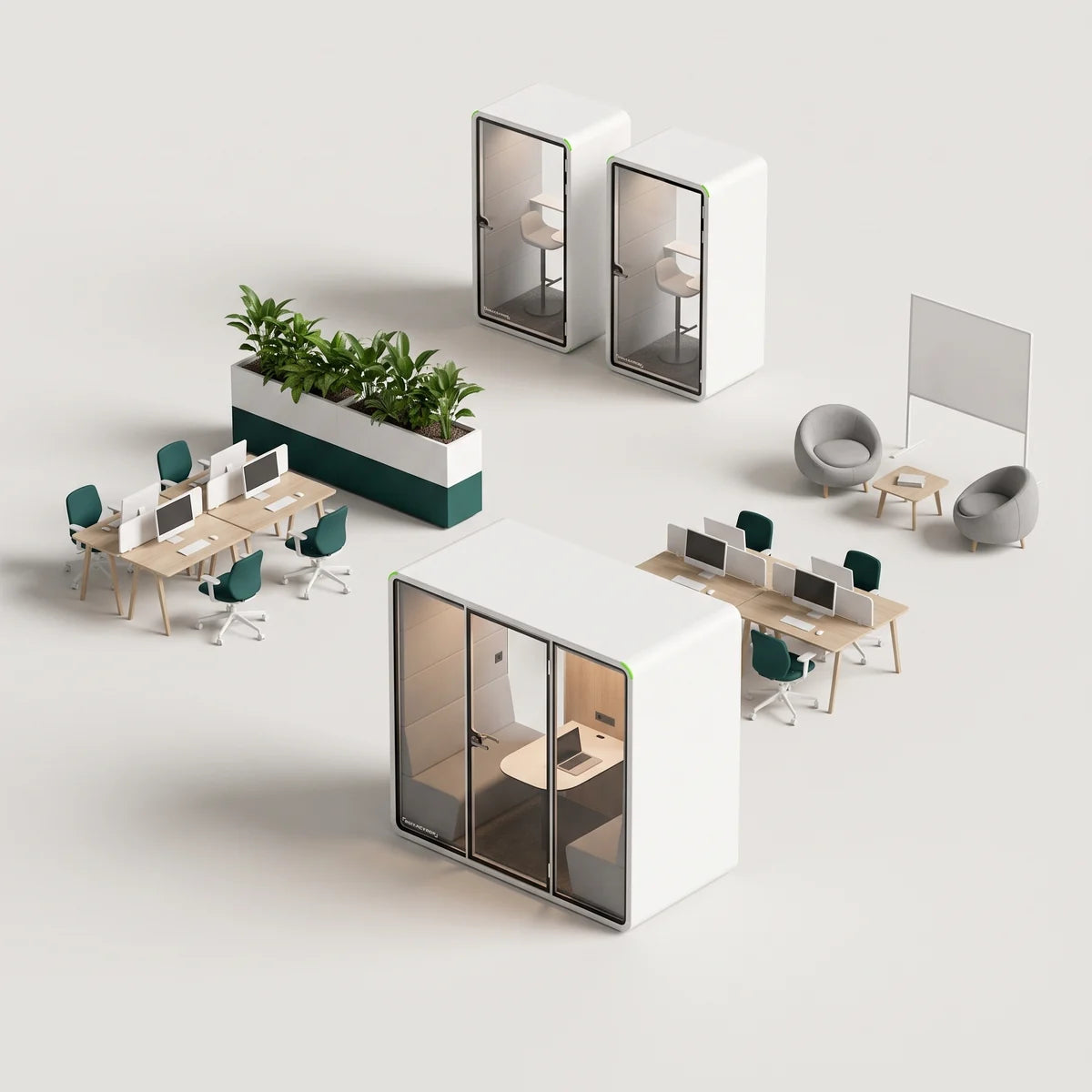
Price out a small meeting space two ways and the gap is hard to ignore. A finished 4-6 person conference room runs $40,000 to $65,000 and takes one to three months. A 6-person office pod runs $14,995, arrives in a week or two, and needs no permit, drywall, or HVAC contractor. Here is where the built-room number goes, and where a pod fits instead.
The short answer
A 6-person office pod like the PrivacyPod XL Pod costs $14,995 delivered, ships free in 1 to 2 weeks, and installs in a few hours with no permit, drywall, or HVAC work. A comparable 4-6 person conference room typically runs $40,000 to $65,000 or more and takes roughly 1 to 3 months of disruptive work once you add framing, mechanicals, AV, furniture, permits, and soft costs. The pod is relocatable and depreciates as furniture; the built room stays behind when you move. Build the room when you truly need a large, permanent boardroom. For the 70 percent or more of meetings with four or fewer people, a pod is faster, cheaper, and more flexible.

Office pod vs conference room at a glance
Every figure below is a fact you can check: the pod is the PrivacyPod XL Pod (6-person), the room a built 4-6 person conference room on 2026 US data.
| Attribute | Office pod (PrivacyPod XL, 6-person) | Built conference room (4-6 person) |
|---|---|---|
| Upfront price (all-in) | $14,995 delivered (L Pod, 4-person: $12,495) | ~$40,000 to $65,000+, up to $95,000 for glass or costly metros (Mammoth 2026) |
| Cost basis | Fixed, published product price | $50 to $250 per sq ft buildout; drywall ~$50 vs glass ~$150 per sq ft (LoopNet; Mammoth) |
| Design / PM soft costs | $0, built into the product | 7 to 20 percent of construction (Mammoth) |
| Infrastructure (HVAC, sprinkler, electrical, data) | $0; self-contained ventilation, standard outlet | HVAC reroute ~$5,000 (new system $100,000+); sprinkler head relocation thousands plus weeks (Mammoth; B&H) |
| Permits / approvals | Typically none; furniture-classified (AHJ has final say) | ~2 percent of construction; permits $30 to $500 each, $2,500 to $8,500 total (HomeGuide) |
| AV + furniture | Integrated furniture kit; USB-C, LED, power built in | AV $4 to $7 per sq ft (~$7,500 basic); furniture $20 to $30 per sq ft (LoopNet; Mammoth) |
| Timeline | 1 to 2 weeks to deliver; install in a few hours | 1 to 3 months, design through construction (B&H; Mammoth) |
| Business disruption | Near-zero; quiet, clean assembly, often after-hours | Weeks of noise, dust, restricted access (B&H) |
| Acoustic performance | ISO 23351-1 Class A, ~30 dB, SGS-validated | Variable; depends on the contractor, no rating guaranteed (B&H) |
| Relocatable / resale | Yes; disassembles, moves, keeps value | No; value drops to ~$0 at move-out, possible demolition cost (B&H; Framery) |
| Accounting treatment | Furniture/equipment (FF&E); may qualify for bonus depreciation or Section 179 | Leasehold improvement / QIP; longer recovery |
| Warranty | 3-year product warranty | None as a unit |
| Best for | The 70 percent or more of meetings with 4 to 6 people; leased, growing, or hybrid offices | Large, permanent, fixed-headcount boardrooms in owned space |
Figures are current as of August 2026 and rounded; confirm pod pricing on the product pages and any construction figure with a local contractor.
What does it cost to build a conference room in 2026?
Budget $40,000 to $65,000 for a finished 4-6 person room, more in a costly city, because it is a stack of trades, not a wall and a table. A ground-up building runs $202 to $574 per square foot (RSMeans, 2026); a fit-out inside existing walls runs less per foot but stacks up across the line items below.
| Line item | Typical cost | Source |
|---|---|---|
| Interior wall framing | $3.88 to $6.62 per sq ft | Homewyse / Angi, 2026 |
| Finished drywall partition | ~$50 per sq ft (glass ~$150 per sq ft) | Mammoth NYC, 2026 |
| HVAC duct / register reroute | ~$5,000 (new system $100,000+) | Mammoth NYC, 2026 |
| Fire sprinkler head relocation | Thousands, plus weeks of approvals | B&H Ergonomics, 2025 |
| Permits and inspections | $2,500 to $8,500 total; ~2% of construction | HomeGuide; LoopNet, 2026 |
| AV (displays, video, speakers) | $4 to $7 per sq ft (~$7,500 basic) | LoopNet; Mammoth NYC, 2026 |
| Furniture (table, chairs) | $20 to $30 per sq ft ($8,000 table, $250/chair) | LoopNet; Mammoth NYC, 2026 |
| Design + PM soft costs | 7 to 20 percent of construction | Mammoth NYC, 2026 |
| Contingency | ~10 percent | LoopNet, 2025 |
The all-in total
Mammoth NYC's 2026 builds anchor the total: a 10x10 breakout room at $21,500 solid or $35,500 glass, an 18x20 conference room at $65,000 solid or $95,000 glass, all-in with furniture, lighting, acoustic treatment, AV, and labor. A focused 4-6 person room sits in the $40,000 to $65,000 band, higher for glass or a costly metro.
What does an office pod cost?
A 6-person PrivacyPod XL Pod is $14,995 delivered and the 4-person L Pod is $12,495, both freight paid and both published list prices, unlike most of the pod market. The XL Pod includes ventilation, LED lighting, USB-C charging, and four furniture-kit options, so the table and chairs sit inside that price.
Every model is rated ISO 23351-1 Class A, about 30 dB of speech level reduction, validated by SGS, with UL 962, GREENGUARD, and ASTM E84 Class A wall panels, 11.14 mm laminated glass, and a 3-year warranty. In-stock pods ship free in 1 to 2 weeks, made-to-order in 8 to 10, and assembly takes a few hours into a standard outlet. Industry-wide, 4-person pods run $11,000 to $25,000 and modular suites $39,999 to $59,999, so a pod stays a fraction of a built room.
What are the hidden costs of building a conference room?
The contractor's quote is not the price you pay, and none of what follows lands on the pod side. B&H Ergonomics calls it the cost iceberg: a room quoted at $20,000 typically finishes at $35,000 to $50,000, or 1.75 to 2.5 times the base.
None of that appears on the pod side. A pod has one price, and the price you see is the price you pay.
Do office pods need permits, drywall, or HVAC work?
Generally, no. A pod is freestanding furniture, so it skips what makes a room a construction project: no drywall (finished panels), no HVAC tie-in (its own ventilation), and no electrician (a standard outlet). That is why it usually falls outside the permit process.
Your local authority having jurisdiction, or AHJ, has the final say, and readings vary by city, occupancy, and use, so ask before you buy; our guide to permits and office pods covers how AHJs view modular booths. In most offices, none is required.
How long does each take, and what is the disruption?
A pod is measured in days, a room in months. A PrivacyPod ships free in 1 to 2 weeks and installs in a few hours, often after the workday ends, leaving a finished pod and a clean floor, with no dust and nothing roped off.
A built room runs the other way: one month at the fast end (B&H), 3 to 6 months for a straightforward fit-out (Mammoth), with framing, drywall, electrical, HVAC, and paint scheduled one after another while the business absorbs the noise and dust.

Can you move it? Flexibility, relocation, and resale
This is where the two separate for good. A pod disassembles and reassembles elsewhere, so it follows you when you relocate, expand, or reconfigure, staying on the books as a movable asset that keeps value. A built room is a fixed leasehold improvement in a space you may not hold in five years; its resale value hits near zero at lease end, and some leases make you pay to demolish it, so you spend $50,000 to build it and may spend again to remove it. For any leased or growing office, it is an asset you keep against a cost you leave behind.

Office pod ROI: focus time and real-estate efficiency
The purchase price is only half the ROI story. Three levers do the rest.
Recovered focus time. Office noise costs workers around 86 minutes a day (iOffice, via Juniper), and about 23 minutes to refocus after each interruption (UC Irvine). At a $40 loaded hourly cost, 30 recovered minutes a day is about $100 a week per heavy user, or roughly $5,000 a year.
Real-estate efficiency. The average dedicated meeting room costs about $15,708 a year to run (iOffice, via Juniper), and roughly 55 percent of a 12-plus person room sits unused, because 70 percent or more of meetings run four people or fewer (B&H) and 80 percent are one to four (Framery). Four pods fit in the 250 square feet of one underused boardroom, quadrupling private-meeting capacity in the same footprint. That is the pod as a right-sizing tool, not just a cheaper room.

Capital preservation. A built room is a sunk cost that hits zero at move-out; a pod is a movable asset you keep and may depreciate, at a third to a quarter of the cost, so the payback is immediate.
Can you write off an office pod? Taxes and depreciation
Often, yes, a real edge over a built room, though the specifics belong with your accountant. A relocatable pod is generally furniture and equipment (FF&E), so it may be eligible to expense in the first year: 100 percent bonus depreciation returned for qualified property placed in service after January 19, 2025, and the Section 179 cap sits near $2.56 million for 2026.
A built room is usually a leasehold improvement, or qualified improvement property, with its own longer recovery. The pod's cleaner tax profile is a point in its favor, but tax rules change and depend on your situation, so consult your tax advisor.
Choose a pod or build a room
Pods and rooms solve different problems, and building is the right call in real cases: a permanent boardroom for 10 to 20 or more people, space you own or hold long-term, a multi-purpose or divisible room, architectural AV built in, or a landlord allowance that funds it. Many offices do both, one boardroom plus pods for the everyday meetings.
Choose an office pod if
- Most of your meetings are four to six people or fewer
- You lease your space, or expect to move, grow, or reconfigure
- You want a fixed, published price and no construction project
- You need guaranteed, lab-verified acoustics (ISO 23351-1 Class A)
- You want the space usable in a week or two, not a quarter
- You want a movable asset you can depreciate and take with you
Build a conference room if
- You need a permanent boardroom for 10 to 20 or more people
- You own the building or hold a long lease
- The room must be multi-purpose or divisible with a partition
- You need architectural AV built into the structure
- A landlord tenant-improvement allowance fully funds the build
- It is a client-facing showpiece where a bespoke look is the point
Office pod vs conference room FAQ
How much does it cost to build a small conference room?
A finished 4-6 person conference room typically runs $40,000 to $65,000 or more all-in, and up to $95,000 in high-cost cities. That covers framing, drywall or glass, electrical, HVAC, lighting, a door, finishes, AV, furniture, permits, and design and project-management soft costs. Construction alone runs $50 to $250 per square foot.
Is an office pod cheaper than a conference room?
Almost always, yes. A 4-6 person PrivacyPod costs $12,495 to $14,995 delivered, against $40,000 to $65,000 or more to build a comparable room. Independent lifecycle studies have found that a small meeting room costs more than the equivalent pod in every city measured.
How long does it take to build a conference room vs install a pod?
Building a conference room takes roughly 1 to 3 months of design, permitting, and disruptive on-site construction. A PrivacyPod ships free in 1 to 2 weeks and installs in a few hours, often after-hours, with almost no disruption to the people working around it.
Do office pods need a permit, drywall, or HVAC work?
Usually no. Pods are typically classified as furniture, have self-contained ventilation, and plug into a standard wall outlet, so they avoid drywall, ductwork, and most permitting. Your local authority having jurisdiction, or AHJ, always has the final say, so confirm before you buy.
What are the hidden costs of building a meeting room?
Soft costs for design and project management add 7 to 20 percent. Relocating a single fire sprinkler head can cost thousands plus weeks of approvals. Permits run $2,500 to $8,500. Then add business disruption, post-construction cleanup, and end-of-lease demolition. A $20,000 quote often finishes at $35,000 to $50,000.
Can you move an office pod later?
Yes. A pod disassembles, moves, and reassembles in a new space, keeping its value as furniture. A built conference room is a fixed leasehold improvement that stays behind when you leave, and its value typically drops to zero at move-out. Some leases even require you to pay to demolish it.
Can you write off an office pod on taxes?
Often, yes. Pods are generally treated as furniture and equipment, and under current 100 percent bonus depreciation they may be eligible to expense in the first year. A built room is usually treated as a leasehold improvement with different, longer recovery. Rules change and depend on your situation, so consult your tax advisor.
Is a pod as private and quiet as a real conference room?
A quality pod delivers guaranteed, lab-verified acoustics. PrivacyPod is rated ISO 23351-1 Class A, about 30 dB of speech level reduction, validated by SGS. A built room's soundproofing is variable and depends entirely on how well the contractor frames, insulates, and seals it, with no rating guaranteed.
Weighing a pod against a build?
Compare the 4-person L Pod at $12,495 and the 6-person XL Pod at $14,995, browse the full meeting pod collection, or see how a pod stacks up against a modular meeting suite in PrivacyPod vs ROOM. Questions on sizing, delivery, or acoustics? Contact the PrivacyPod team, email info@privacypod.ai, or call (877) 774-8763.
Source note: Construction figures are published 2025-26 US cost data reflecting typical ranges, not a quote; a real room can cost more or less by city and finish. PrivacyPod prices ($12,495 L Pod, $14,995 XL Pod, free Quick-Ship) are current as of August 2026. Tax notes are general, not advice; consult your tax advisor. Sources accessed August 5, 2026.
- RSMeans / Gordian, 2026 (office build $202 to $574 per sq ft).
- LoopNet (CoStar) (buildout $50 to $250 per sq ft; soft costs, AV, furniture, permits, contingency).
- Mammoth NYC, 2026 (breakout $21,500 / $35,500; conference $65,000 / $95,000; drywall ~$50 vs glass ~$150 per sq ft; soft costs 7 to 20 percent).
- B&H Ergonomics, 2025 (iceberg 1.75 to 2.5x; sprinkler relocation; disruption; 70 percent of meetings four or fewer).
- Juniper Office / iOffice (average meeting room $15,708/year; 86 minutes/day of noise loss).
- Framery with CBRE (small rooms cost more than the pod in every city; 80 percent of meetings one to four).
- HomeGuide, permit costs, 2026; Homewyse / Angi, wall framing, 2026.
- Section 179 and bonus depreciation summaries (100 percent bonus depreciation for property placed in service after January 19, 2025; Section 179 cap ~$2.56M for 2026); QIP guidance. General only.
- PrivacyPod XL Pod and L Pod product pages for pricing, specs, and ISO 23351-1 Class A (SGS-validated) acoustic figures.
Filed under Buying guides
Back to the blog